School Risk Score Algorithm (Audit Intelligence)
CONCEPT
Designed and implemented a school risk scoring algorithm to support audit planning using historical audit and operational data. The solution standardises school risk signals into a governed feature set, calculates a weighted risk index with threshold‑based risk bands, and presents results through a centralised Power BI scorecard to enable faster, more consistent, and more targeted audit planning and fieldwork.
DATA PIPELINE
Oracle EBS and audit data → feature engineering and normalisation → Python scoring (Qlik Server) → scored outputs stored in MySQL (QlikView database tables) → Power BI scorecards and role‑based reporting.
PROGRAM DESIGN
1) School Data Feature Set
- Designed school feature set parameters (50–100 dimensions).
- Secured approval from leads and stakeholders.
- Validated feature definitions and business rules.
- Defined source‑to‑target mappings for traceability.
- Developed a normalised dataset for consistent scoring and reporting.
- Documented re‑scoring procedures and governance.
2) Risk‑Based Planning
- Worked with cross‑functional teams to agree risk measures and audit control factors.
- Designed scoring logic for key control factors and risk measures.
- Defined risk indexing, ratios, benchmarks, and indices.
- Integrated risk measures into the School Feature Set for end‑to‑end scoring.
3) School Audit Scorecard
- Built a centralised intelligence platform for school audits.
- Ensured consistent measures across all views and reporting layers.
- Delivered role‑based views tailored to operational needs (Auditor, Audit Manager, Audit Director).
- Supported faster planning and fieldwork through improved risk visibility.
REPORTS & DELIVERABLES
4) School Data Feature Set
- Delivered a centralised single source for school insight and intelligence.
- Provided consistent insights across all school audits.
- Reduced ad‑hoc analysis and rework via governed definitions and datasets.
- Lowered data handling and analysis time through standardisation.
5) Risk‑Based Planning
- Established standards of practice to monitor school risk factors.
- Enabled segment‑based scoring aligned to audit types.
- Incorporated commercial rules and operational needs into planning.
- Improved targeting of schools based on audit need and risk.
6) School Audit Scorecard
- Delivered a centralised intelligence platform for audit planning and monitoring.
- Maintained consistent measures across all scorecard views.
- Enabled unique views based on operational needs for each role.
- Provided an integrated dashboard solution (Auditor, Audit Manager, Audit Director).
RISK SCORING METHOD
Implemented a weighted index model to compute an overall risk score from multiple risk measures and audit control factors. Each factor was standardised and weighted based on agreed audit significance, then aggregated into a single score. Thresholds were applied to assign schools into risk bands (for example: Low, Medium, High) to support prioritisation and planning decisions. The approach was designed to be transparent, repeatable, and governed, with documented re‑scoring procedures.
APPROACH
Data was sourced from Oracle E‑Business Suite (Oracle EBS) and audit datasets,
then transformed into a normalised analytical feature set. The scoring logic was implemented using
native Python and executed via Qlik Server to support scheduled,
repeatable runs.
Scoring outputs and supporting audit metrics were persisted into MySQL tables within the
QlikView database, providing a stable, queryable layer for reporting. These curated tables
were then used to power a Power BI audit scorecard with role‑based views and consistent
measures across planning, triage, and oversight.
TECHNOLOGIES USED
- Enterprise Source Systems: Oracle E‑Business Suite (Oracle EBS)
- Processing & Scoring: Native Python (weighted index + thresholds)
- Execution / Scheduling: Qlik Server (Python operationalisation)
- Data Store for Outputs: MySQL (QlikView database tables)
- Dashboards & Scorecards: Power BI (role‑based views)
- Data Modelling & Governance: feature validation, source‑to‑target mapping, normalised dataset design
OUTCOME
Established a repeatable, governed risk scoring framework and a centralised audit intelligence scorecard. Improved consistency of audit planning measures, reduced manual analysis and ad‑hoc rework, and enabled focused targeting of schools through clear risk bands derived from weighted indices and thresholds.
View Documentation / Demonstration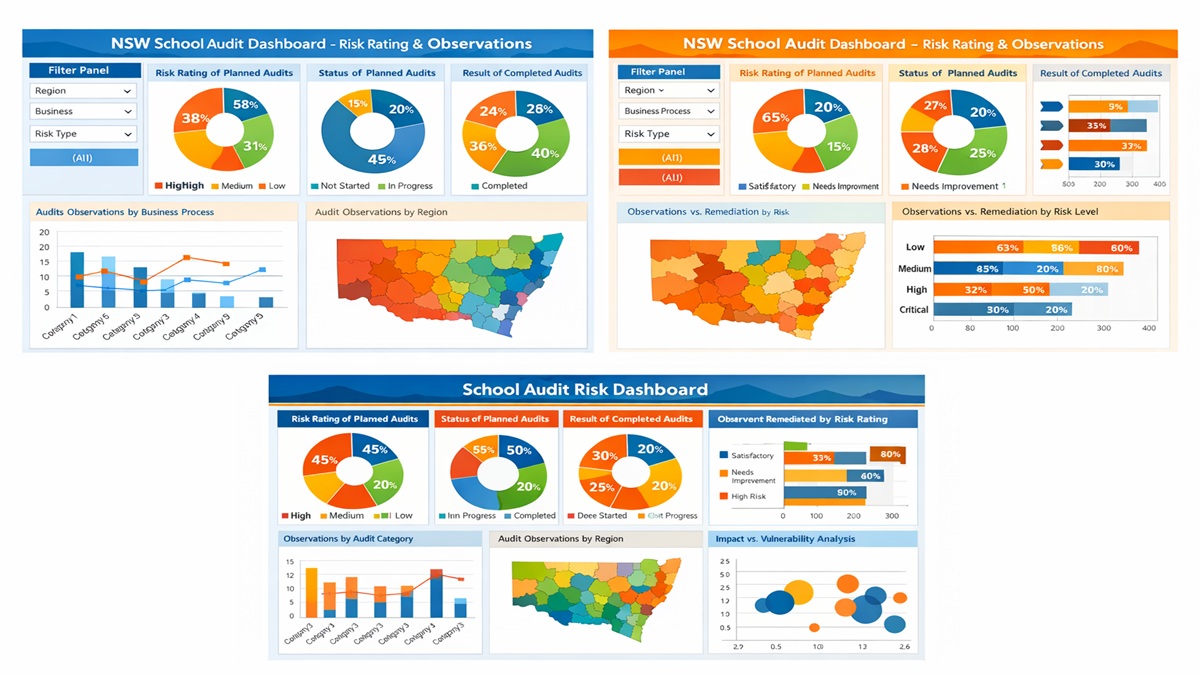
Power BI Audit Scorecard (Role‑Based Views)